

Human Trafficking Convention 2027-Two Days!
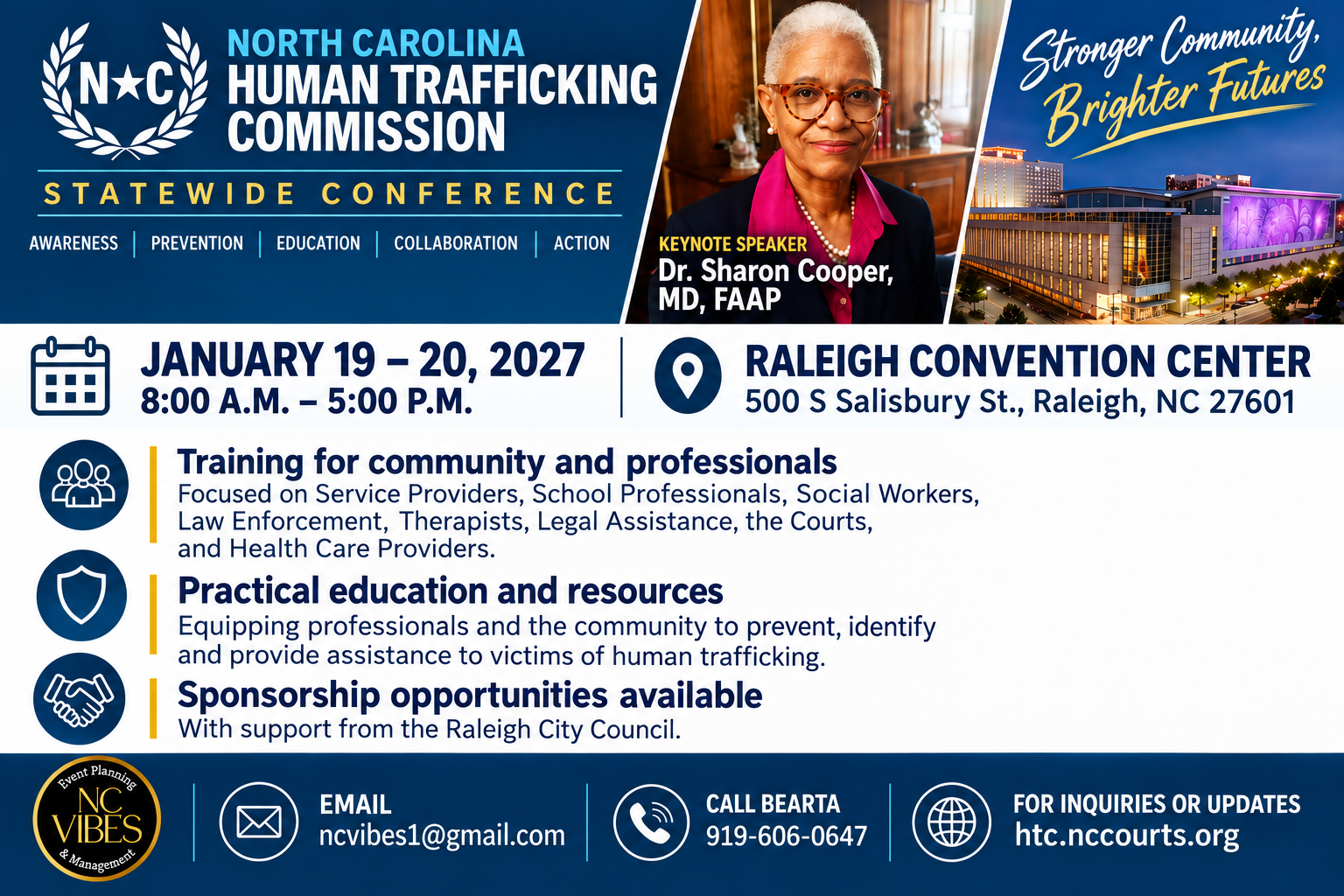
Raleigh Convention Center-Atlantic Union Bank Convention Center
Raleigh, NC
Tuesday, January 19, 2027 • 10 AM – 5 PM
Overview
Join professionals, advocates, law enforcement, educators, & community leaders from across NC for a two-day statewide conference.
The North Carolina Human Trafficking Statewide Conference will take place January 19–20, 2027 at the Raleigh Convention Center, bringing together professionals and community members from across the state for two days of education, collaboration, and meaningful discussion.
The conference will feature nationally recognized experts, keynote presentations, plenary and panel discussions, and a variety of breakout sessions addressing critical issues surrounding human trafficking, child sexual exploitation, prevention, identification, intervention, and survivor support.
Attendees will have opportunities to learn from experts in the field, exchange ideas and best practices, connect with organizations and resources, and strengthen partnerships across agencies and communities.
The program will include a keynote presentation by Dr. Sharon Cooper on “The Polyvictimization of Child Sexual Exploitation” along with additional plenary sessions, breakout sessions, panel discussions, vendor exhibits, networking opportunities, and a closing panel.
This conference is designed for law enforcement, judicial and legal professionals, educators, healthcare professionals, social workers, victim service providers, nonprofit organizations, government agencies, community leaders, students, advocates, and others committed to preventing human trafficking and supporting those impacted by exploitation.
Join us as we bring together knowledge, resources, and people from across North Carolina to strengthen our collective response to human trafficking.
Please note: this event is a two day event and ticket price is for two days. Attendees may attend one day or two days for the same price.
DISCOUNTED HOTEL ROOMS ARE LIMITED – PLEASE SECURE YOURS ASAP
(COPY PASTE THIS LINK)
https://www.marriott.com/event-reservations/reservation-link.mi?id=1791825112579&key=GRP&app=resvlink&_branch_match_id=1421450771088776317&_branch_referrer=H4sIAAAAAAAAA8soKSkottLXTywo0MtNLCrKzC8p0UvOz9UvSi0uy0wtN7LPTLE1NLc0tDAyNTQ0MjW3VMtOrbR1DwpQSywosAWpysnMy1arK0pNSy0qysxLj08qyi8vTi2ydc4oys9NBQC8adnhYQAAAA%3D%3D
Sponsors are welcome!
AGENDA
Human Trafficking Commission 2027 Conference — Presentation Summaries
The Poly-victimization of Child Sexual Exploitation — Dr. Sharon Cooper, Keynote
Examines different forms of child sexual exploitation and draws from Dr. Cooper’s work and co-authored research on the medical, legal, and social aspects of exploitation.
From Awareness to Action: Using Hotline Data to Strengthen Human Trafficking Prevention and Response — Tiffany Taylor & Drew Carter
Uses FY 2026 National Human Trafficking Hotline data and North Carolina-specific information to show who contacts the Hotline, why they reach out, and how those contacts lead to services, law-enforcement involvement, child-welfare response, and other forms of assistance. The session focuses on using data to identify trends, improve prevention, and connect people to resources.
Effectively Advocating for System-Involved Child Victims of Human Trafficking — Bethany Gilot & Hannah Hopper
Uses a case-study approach to explain how child-welfare systems respond to suspected or confirmed trafficking. It covers mandatory reporting, advocacy, trauma-responsive care, youth-centered approaches, and collaboration among professionals serving children and youth.
Beyond Stabilization: Mental Health Treatment for Trafficking Survivors — Kailey Kelley
Focuses on survivors’ longer-term mental-health needs after immediate safety and crisis stabilization. Topics include complex trauma, attachment, identity, emotional regulation, shame, survival behaviors, and individualized treatment. The session emphasizes that survivors should not be treated as one clinically uniform group.
Fraud and Financial Crimes — How It Relates to Human Trafficking — Freddy Massimi
Explores how trafficking activity can leave financial patterns and transactional red flags. Attendees will learn about money movement, laundering, financial indicators, and how fraud-detection techniques can help identify trafficking networks.
Collaborative Approach to Human Trafficking Investigations — Lauren Darden & Kory Williford, FBI
Explains how law enforcement, victim-service providers, and forensic interviewers can work together during trafficking investigations. The focus is on the different roles each discipline plays and how collaboration can strengthen investigations and victim support.
FBI Miami Shooting — We Cannot Fix What We Cannot Talk About — Lauren Darden
A debrief of the February 2, 2021 FBI shooting in Miami in which two agents were killed and four agents were wounded. The session discusses operational planning, lessons learned, and changes made afterward. The document states that this session is restricted to sworn law enforcement and prosecutors.
Interdiction for the Protection of Children — Sergeant Mark Nales II, NC State Highway Patrol
Trains law-enforcement personnel to recognize situations involving children who may be missing, exploited, or at risk and introduces resources that can help officers determine a child’s status and identify high-risk threats.
Vetting Certification and Standards of Care — Christine Long & Latiana Appleberry
Introduces a new Human Trafficking Commission Vetting Certification program developed in collaboration with Survivor Network North Carolina and provides an overview of the program.
Complicated: The Intersection of Child Welfare and Child Trafficking — Hope Connie Wertz & Hannah Hopper
Discusses situations where trafficking, child welfare, family dynamics, and the legal system overlap. The session focuses on identifying cases early, barriers to coordination, and improving collaboration among systems.
Closing the Policy Gaps: How Education, Foster Care, and Mental Health Reform Can Prevent Trafficking and Support Recovery — Stacy Reynolds
Uses case studies from Atrium Health’s anti-trafficking program to examine gaps in foster care, mental-health services, education, managed care, and other child-serving systems. The session focuses on how these gaps can increase vulnerability and how cross-system collaboration can improve prevention and recovery.
The Perfect Plan: How Traffickers Use Forced Criminality to Escape Accountability — Jane Anderson
Examines how traffickers may force victims to commit crimes and how that can cause victims to be mistaken for offenders. The session covers grooming, coercion, sex and labor trafficking, and practices designed to help professionals identify forced criminality and avoid inappropriate punishment of victims.
Missed Opportunities: Closing Gaps in Identifying Labor Trafficking — Jane Anderson
Focuses on labor trafficking, involuntary servitude, and debt bondage across industries such as agriculture, manufacturing, construction, service industries, entertainment, and domestic labor. It emphasizes coordination among government agencies, courts, healthcare, schools, churches, and other organizations to identify victims and build stronger cases.
More Than a Voice: Rethinking Survivor Engagement, Power, and Practice — Latiana Appleberry
Examines what “survivor-centered” and “trauma-informed” practice looks like in actual organizations. The session distinguishes between simply including survivor voices and meaningfully sharing decision-making power with survivors.
The Financial Fingerprint of Human Trafficking — Jordan M. Ford
This presentation is listed with Jordan M. Ford, Chief Financial Crimes Resource Prosecutor for the NC Conference of District Attorneys,